
Retaining wall repair, replacement and installation in Worcester, MARequest an estimate
Worcester planning guide

Retaining Wall Repair vs. Replacement

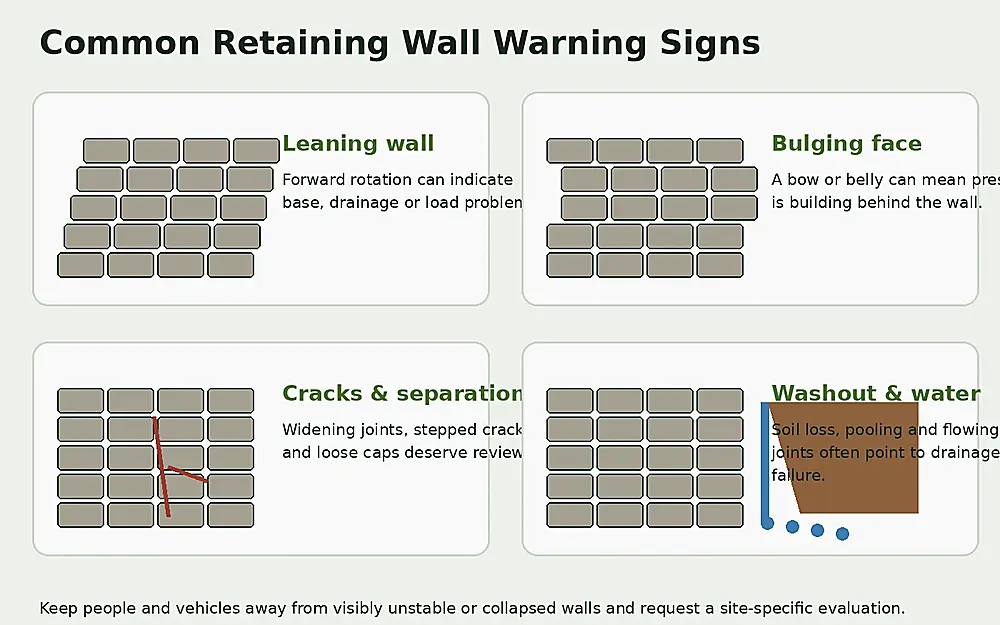
The best decision is based on the failure pattern, not the homeowner’s preferred price point. Localized movement over a serviceable base may support repair. Widespread rotation, failed timber, poor foundation and repeated patching usually point toward rebuilding or replacement.

The most important question is whether the repaired wall will still rely on failed hidden components. A face patch may be inexpensive today but poor value if the base, backfill and drainage remain unchanged.

Key points to review

  • Repair may fit when movement is localized
  • Rebuilding may fit when face material is reusable but the base failed
  • Replacement may fit when material and foundation are deteriorated throughout
  • Engineering may be needed where walls carry major loads
  • Drainage correction should be included whenever water contributed
  • Compare expected service life, disruption and warranty scope
Retaining wall planning illustration

How to use this information

Walk the full length of the wall from a safe location. Photograph the wall face, both ends, the area above it and any drainage outlets. Note the highest exposed point, what the wall supports and whether the condition changes after rain or winter. This creates a more useful starting point for contractors and design professionals.

Official resources: Review the City of Worcester building and zoning guidance and the Massachusetts Dig Safe guide before excavation.

Questions homeowners ask

Can I use this guide instead of a site evaluation?

No. The guide helps you document conditions and ask better questions, but hidden base, soil and drainage conditions usually require an on-site review.

What should I send with an estimate request?

Include wide photos, close-ups, approximate length and height, the property address, access information and what sits above the wall.

Should I get multiple quotes?

Yes. Compare scope, materials, drainage, exclusions and responsible provider details, not only total price.

When should an engineer be involved?

Consider engineering when the wall is tall, supports vehicles or structures, sits on a difficult slope or shows movement that is not readily explained.

Related guides and services

Choose based on remaining system value

A practical Worcester repair-versus-replacement test

Repair makes sense when a defined portion failed, the adjacent base and wall remain stable, drainage can be corrected and the rebuilt section can connect to sound work. Replacement becomes more likely when movement is widespread, material is deteriorated throughout, the base is inconsistent or the wall was never designed for the load it carries.

Do not compare only the repair price with the replacement price. Compare expected service life, access disruption, repeated mobilization, ability to match material and the risk that a small repair exposes a larger failure. A low-cost patch can be expensive if the owner must remove it again to complete the correct work.

For Worcester stone walls, reuse may preserve character and reduce disposal, but sorting and rebuilding can be labor intensive. For timber walls, hidden decay may make repair unreliable. For segmental block, the condition of buried courses and reinforcement matters more than the appearance of a few face units.

  • How much of the wall is still stable?
  • Can the original cause be corrected within the repair limits?
  • Is the material durable enough to justify reuse?
  • Will the repair connect to sound base and drainage?
  • What is the consequence if movement continues?

Tell us what is happening with your wall.

Upload a few photos, the property address and an approximate size. We will use those details to route the request and follow up about the next step.

Request a Free Estimate
Free Estimate